Acknowledgement of Country
Our Service Centres sit on Dharug Country.
Ampol acknowledges the Dharug people as the traditional Custodians of this land, and pays respect to their ancestors and elders past, present, and emerging.
We acknowledge that Aboriginal peoples have cared for and preserved the land and waters for thousands of years and continue to maintain strong connections to culture and Country.
.png)
Balarinji
Balarinji, Australia’s foremost Indigenous design and strategy studio, has supported us to develop Aboriginal artworks and narratives for our Eastbound and Westbound Service Centres at Eastern Creek, creating a space that connects with Dharug knowledge and stories, allowing travellers to rest and revive while appreciating the local culture.
Dharug Ngurra ‘Country’
The pulse of Community and Country is an interconnected rhythm shaped by the six distinct seasons of Dharug Country.
These seasons symbolise shifts in weather and environment, while guiding cultural practices, ceremonies, and daily life. They speak to deep and ongoing connections to Country — dynamic, enduring, and ever present.
The pair of artwork installations in the dining halls of the Eastbound and Westbound Service Centres tells this story.
The Dining Hall Installations
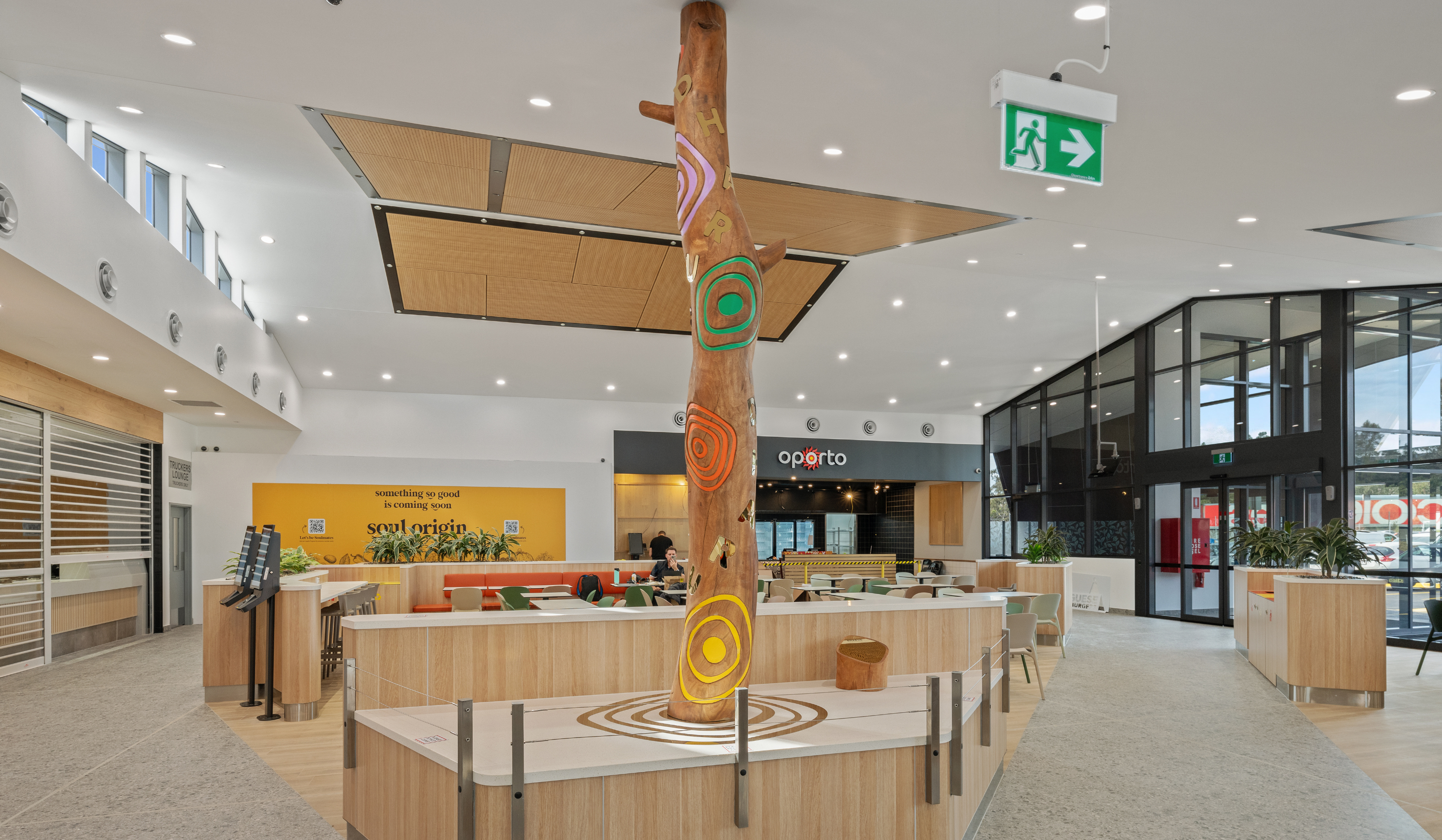
The artwork installations by local Ngemba-Dharug artist Jamie Eastwood are a contemporary interpretation of a scarred tree — a traditional and intentional practice used to mark and communicate connections to Country. Scarred trees served important purposes such as guiding people to water, signalling direction, and providing materials for culturally significant objects like shields, coolamons, and canoes.
On the Eastbound artwork, The word Dharug stands bold. On the Westbound artwork, The word Ngurra (Country) is proudly displayed. Together they acknowledge the traditional custodians of the land on which you stand, while graphic forms reflect the interconnected pulse of community and Country.
Colours woven through the design reflect the six seasons of Dharug Country. These seasons symbolise shifts in weather and environment and also guide cultural practices, ceremonies and daily life.

Jamie Eastwood
Jamie Eastwood is a Ngemba-Dharug man who has worked on both large and small-scale art projects. He has been a practising artist for more than 20 years and has lived and worked in the Sydney region throughout his life. As a visual artist, primarily using acrylic paint, his work has been exhibited widely. He has won several awards, including being named NSW Aboriginal Artist of the Year, receiving the Centennial Medal Award for service to the arts, and being honoured as the Young Australian Citizen of the Year by Parramatta City Council.
Jamie has a wealth of experience, particularly in mural installations and designs, and loves to teach and pass on his skills and knowledge to others. He is passionate about telling the stories of his Aboriginal culture through art, both in traditional and non-traditional ways. By doing so, he hopes to keep the Dreaming alive.
Instagram: eastwood9374
Behind the Scenes Collaboration
Balarinji’s creative process for the Ampol Eastern Creek Service Centre artworks began with deep collaboration with local Dharug knowledge holders. Through a series of conversations, the team listened to community stories of Country and explored how culture could be meaningfully reflected and celebrated in the space.
Working in partnership with Ampol and commissioned artist Jamie Eastwood, Balarinji co-designed storytelling concepts grounded in the community’s vision. This Dharug-led approach shaped a culturally rich foundation for the artworks.
What followed was a detailed design development phase. Captured in the visuals are concept drawings, material samples, and the hands-on fabrication process. Each step reflects the care, creativity and cultural integrity embedded in the project.
This collaboration valued the expertise of all involved and led to the creation of artworks that speak to a living, contemporary Dharug identity through the language of art.

Ampol acknowledges the Traditional Custodians and diverse cultures of the local land on which we live, work, and operate. We pay our respects to Elders past and present.